
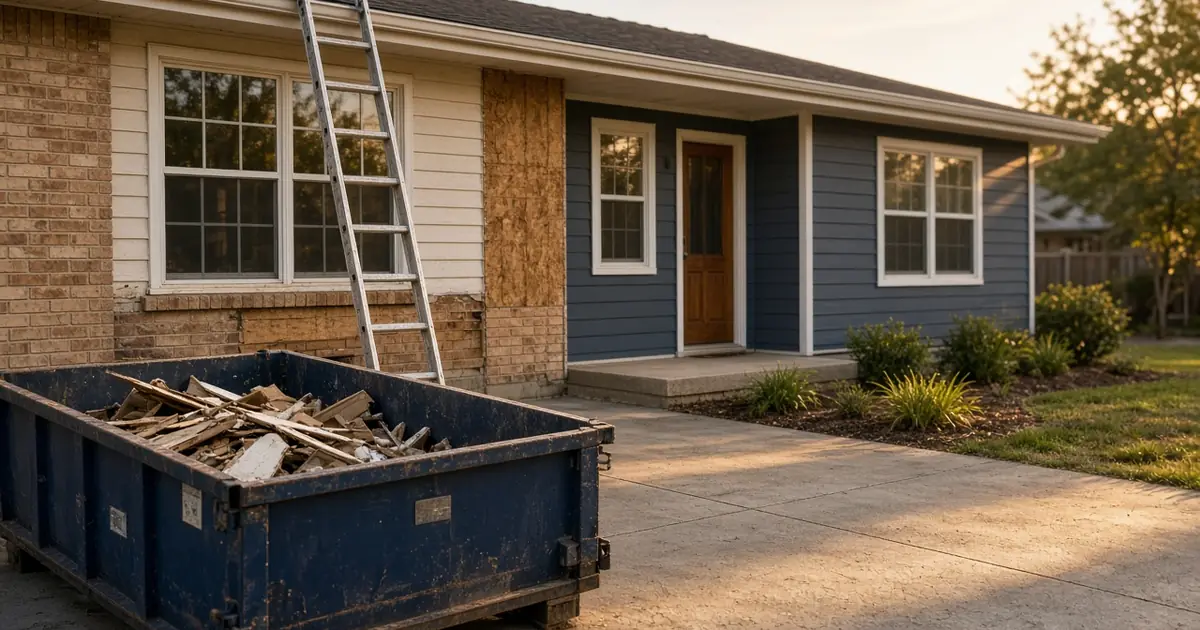
What is the BRRRR method?
BRRRR is a portfolio strategy. The letters stand for buy, rehab, rent, refinance, and repeat. You take title on a property that can appraise for more after work, renovate it, lease it, and replace the short-term debt with a long-term loan sized from the new value and the rent. Cash that comes back at the refinance, when the numbers support it, can fund the next purchase. The loop recycles those dollars when the new loan retires the short-term balance, covers refinance costs, and returns a useful share of the cash you put in. A light appraisal, a light rent, or a lower refinance loan-to-value leaves the rental in place and leaves more of your cash in it.
This page stays with the full sequence. Investors who already hold a stabilized rental should start on the DSCR cash-out refinance page. Builders First Funding is a loan broker, not a direct lender. We compare 100+ lending programs, and coverage is nationwide. Approval and the cash that comes back depend on the program.
The five steps at a glance
Rent is the step with no new mortgage: you stabilize the property while the short-term loan is still outstanding. The table maps each step to a loan. The sections after it use the terms already published on this site.
| Step | Goal | Loan |
|---|---|---|
| Buy | Take title on a property that can be worth more after work | Fix and flip loan, or a bridge loan on a tired rental |
| Rehab | Finish the scope that supports the higher value | Draws on that same short-term loan |
| Rent | Stabilize the property with income a lender can use | No new loan — you carry the short-term loan |
| Refinance | Pay off the short-term loan and recover cash | DSCR cash-out refinance |
| Repeat | Buy the next property with cash the refinance returned | The next short-term loan, then another DSCR loan |
Financing each BRRRR step
The loan that fits the first half of a BRRRR is a fix and flip loan, sometimes called hard money, because it funds the purchase and the rehab on a short term. The loan that fits the refinance is a DSCR loan, because it qualifies on the property's rent rather than on W-2s or tax returns. One team can line up both before you close the purchase.
Buy and rehab with a fix and flip loan
For a house that needs real work, start with fix and flip loans. Rates start at 9%, terms run 6–18 months, and the minimum loan is $100,000. Leverage is commonly up to 80% of after-repair value, and the typical quote is interest-only for the life of the rehab. Acquisition funds at closing. Rehab funds go out in draws after the work is inspected. Term sheets are turned in 24 hours, and a closing can happen in as few as 10 business days when title, the entity documents, the budget, and insurance are ready.
Some programs size the loan as up to 90% of the purchase price plus up to 100% of the approved rehab budget, still capped at 80% of ARV. The sample later uses the 90% plus 100% structure because that is what the fix and flip FAQ describes for some programs. A first-time flipper can qualify, often with a lower cap, a higher rate, and a closer look at the budget.
A bridge loan fits a tired rental where the work is lighter. Bridge loans go up to 75% loan-to-value, run 6–24 months, and are interest-only. They carry a purchase that will not clear a DSCR test today because the in-place rent is below market, until that rent is raised. A bridge from a flip into a DSCR refinance is often about 90–180 days. Use the fix and flip loan when the rehab budget is the project.
What is the 80% rule, and what is ARV?
After-repair value, or ARV, is the price the property should appraise for once the rehab is done. Fix and flip loans are capped at up to 80% of ARV. Some programs advance up to 90% of the purchase price plus up to 100% of rehab, still capped by ARV. The loan follows finished value, so the appraisal sets the ceiling.
Investors also use 80% as a purchase rule of thumb: keep the offer at or under 80% of ARV minus rehab. That is a buying formula. The lender's cap is a loan formula. Both depend on an after-repair value the appraiser sets from closed sales of finished homes. Run the comps and the max offer in the ARV calculator and loan-to-cost guide. In the sample, 80% of a $260,000 ARV is $208,000, and the $185,000 loan fits with $23,000 of room. At a $225,000 appraisal, 80% is $180,000 and that same loan no longer fits.
The build variant: BRRRR with ground-up construction
Yes. BRRRR works on a new house as well as a rehab. You fund the build with a ground-up construction loan, lease the finished home, and refinance into a DSCR loan. Spec home financing is the usual construction product when there is no end buyer under contract and the plan is to hold the home as a rental.
New construction loans go up to 90% of loan-to-cost, with rates from 9.5%, terms of 12–24 months, and a minimum loan of $150,000. The published exit is a sale or a DSCR loan. Spec home financing is the ground-up loan for a house with no buyer under contract, which is the ordinary setup when the exit is a lease. Hard money construction loans are the asset-based version, with interest-only payments and closings in as few as 10 business days when the file is ready. Spec programs are interest-only during construction as well.
Draws usually cover the lot and the build as phases are inspected. The construction term has to cover the build, the lease-up, and the seasoning the refinance needs, or you add a bridge after the certificate of occupancy. A 12-month term is tight once a six-month cash-out seasoning period shares the calendar. An 18- or 24-month term leaves room. The build-to-rent article covers why some builders hold new houses. Most new-construction programs prefer at least one completed build. Some look at a first project, often around 60–65% loan-to-cost, when a general contractor with a verifiable history is on the team.
Rent: stabilize the property and get a lease signed
Rent is the step with no new mortgage. The short-term loan is still in place, the work is finished, and the income has to be something a DSCR lender can read. Programs use a current lease or the appraiser's market-rent estimate. A signed lease is the cleaner file.
Rehabs and lease-ups run past the first schedule, and the short-term loan keeps accruing. Interest, taxes, insurance, utilities, and any association dues continue while you wait. The sample parks an assumed $15,000 beside the down payment so those carrying costs are visible. The rent you sign is the numerator in every refinance scenario. Underwrite the rent a tenant in that neighborhood will sign.
Refinance into a DSCR cash-out
The refinance step is a DSCR cash-out refinance: a new 30-year loan, rates from 5.99%, qualified on the property's rent, with no W-2s and no tax returns. Cash-out loan-to-value is program-specific. It moves with credit, the DSCR ratio, and seasoning. Most cash-out programs want at least a 1.0x DSCR, so the rent covers the new and larger payment, and programs can flex to 0.75x with compensating factors. The DSCR loans page publishes a maximum of 80% loan-to-value and a minimum ratio of 0.75x for DSCR loans. Those published DSCR figures are the product terms. Cash-out loan-to-value stays program-specific, which is why the sample shows 80%, 75%, and 70% as separate scenarios.
The new loan pays off the short-term balance, pays the refinance costs, and sends you what remains. If nothing remains, you bring cash to that closing. Use of proceeds is unrestricted, and LLC vesting is allowed. A rate of 5.99% is a starting rate. A higher rate raises the payment and lowers the DSCR.
Repeat: the next property
Repeat means another acquisition, funded by the cash the refinance returned plus whatever you add. DSCR programs do not cap the number of financed investment properties. Conventional loans often stop investors around 10 financed properties. Each new DSCR loan is judged on that property's rent. Eligible homes are non-owner-occupied single-family houses, townhomes, condos, and small multifamily of 2–4 units. Some programs also consider 5 or more units.
Qualifying often includes the down payment and reserves a program wants, commonly about 20–25% down plus six months of reserves on a purchase. Many DSCR loans also carry a prepayment penalty of about three to five years, so a plan to refinance again quickly belongs in the term sheet. Cash left in the property is the cost of the rental you kept.
DSCR loan requirements for a BRRRR refinance
DSCR loan requirements turn on rent versus PITIA, the full monthly housing payment. For DSCR loans, Builders First Funding publishes leverage up to 80% loan-to-value, a minimum DSCR of 0.75x, and credit from 660, with some programs flexing to 620. No tax returns are required, because the property's rent qualifies the loan.
Read DSCR loan requirements against the refinance payment, which grows as you take more cash out. Most cash-out programs want 1.0x. The 0.75x minimum is a flex when other parts of the file compensate. Ratios around 1.25x are where pricing is usually strongest.
How DSCR is calculated
DSCR equals monthly rent divided by PITIA. PITIA is principal and interest, the monthly share of property taxes, the monthly share of insurance, and association dues. A ratio of 1.0 means the rent equals that payment. Leaving taxes and insurance out makes the ratio look stronger than the lender's ratio. The DSCR calculator takes a rent and a full PITIA, or it builds the payment from the loan, the rate, and the tax and insurance lines. Test a rate above the 5.99% starting point. For the short-term side, estimate your loan with the hard money and construction calculator, then price the refinance here.
Seasoning: how long before you can refinance
The wait depends on the lender's seasoning rules and on whether you want cash out or only a rate-and-term refinance. Most programs look for six months of ownership before a cash-out, and some allow three months through a delayed financing exception. Rate-and-term refinances typically have no seasoning requirement. Plan the short-term loan's term to cover the rehab, the lease-up, and that waiting period.
The cash-out page uses the same timeline. Delayed financing has its own conditions, including an arm's-length purchase and documented funds, covered in the delayed financing guide. Seasoning is generally counted from the date you took title, so part of the rehab can overlap the wait. Choose a fix and flip term inside the published 6–18 month range with slack after the draws. If maturity arrives first, a bridge of about 90–180 days is the usual hold into the DSCR loan.
Credit scores by step
Across programs, minimum scores vary and can start as low as 600 when the rest of the file is strong. On fix and flip loans, most programs want 620 or better, and the cleanest pricing typically wants 660 or better. Below 620 the menu gets smaller, and stronger deal economics, finished projects, or more equity can keep a file in play. On DSCR loans the line is 660, with some programs flexing to 620. New construction programs talk first about completed builds and the general contractor. One score does not travel unchanged from the rehab loan to the rental loan.
Can a first-time investor do BRRRR?
Yes. Builders First Funding works with first-time investors on fix and flip, DSCR, rental, and new construction programs. Experience can improve the terms. On a first BRRRR, the program may ask for slightly more equity, which means a higher down payment, and the team spends extra time walking through the process.
A first BRRRR uses those programs in order. Bring a purchase price, a scope, an ARV, a contractor quote, reserves for delays, and a clear exit. On a first ground-up project, plan on a general contractor with completed work and a loan-to-cost that may sit nearer 60–65%.
Sample BRRRR deal (illustrative)
The cash you need is the sum of the down payment, closing costs, holding costs, and reserves, and the sample deal below is the clearest way to see it. In that illustration, ten percent down is $15,000 and assumed closing and holding costs are another $15,000, so about $30,000 goes in before the refinance. What you get back depends on the refinance loan-to-value.
Illustrative only
Hypothetical numbers for a sample deal. This is not a quote, a rate lock, or an offer to lend. Rent, taxes, insurance, closing costs, and holding costs are assumptions. Loan structures cited here are the ones already published on this site.
The short-term loan is 90% of the $150,000 purchase plus 100% of the $50,000 rehab, $185,000 in total, under the $208,000 ARV cap. Cash in is $30,000. The example holds through month 6, the seasoning most cash-out programs look for. Payments use a 30-year amortization at the 5.99% starting rate plus the assumed $350 of taxes and insurance. Refinance costs are an assumed $6,000. Figures below are rounded.
Cash-out loan-to-value is program-specific, so the table shows three scenarios. The 80% row uses the maximum published for DSCR loans. The 75% and 70% rows are lower scenarios. No row is a Builders First Funding cash-out loan-to-value cap.
| Refinance LTV scenario | New loan | P&I, 30-year | PITIA | DSCR | Cash after $185k payoff + $6k | Cash left in the deal |
|---|---|---|---|---|---|---|
| 80% scenario | $208,000 | $1,246 | $1,596 | 1.32x | $17,000 back | $13,000 |
| 75% scenario | $195,000 | $1,168 | $1,518 | 1.38x | $4,000 back | $26,000 |
| 70% scenario | $182,000 | $1,090 | $1,440 | 1.46x | $9,000 short | $39,000 |
The lesson is the cash-out loan-to-value. At a 5.99% starting rate, all three scenarios clear a 1.0x DSCR, from about 1.32x to about 1.46x. The rate is not what decides whether you can repeat. At the 80% scenario the new loan is $208,000. After the $185,000 payoff and $6,000 of assumed costs, about $17,000 comes back, and about $13,000 of the original $30,000 is still in the property. At 75%, about $4,000 comes back and about $26,000 stays in. At 70%, the new loan is $182,000, about $9,000 short of the payoff plus costs. You bring that cash to the refinance, and about $39,000 is left in the deal.
A $240,000 appraisal turns an 80% scenario into a $192,000 loan. Rent of $1,700 against the 80% PITIA of about $1,596 is a ratio near 1.06x. A deal worth buying should still work on the middle row. Re-run your rent in the DSCR calculator.
Not financial advice. Market data and deal scenarios shown here are illustrative and based on public information available at time of publication. Investors should perform their own due diligence on current market conditions, property-level economics, insurance, and local regulations before making investment or financing decisions.
Common reasons a BRRRR refinance comes up short
Four misses move the cash that comes back, and each one is visible before you own the house if you write it down.
The appraisal comes in below the plan
The refinance loan is a percentage of appraised value, and the fix and flip loan is capped by ARV. A short appraisal shrinks both. Leave room between the loan you need and the cap.
The rent comes in below the plan
DSCR uses the rent the lender will accept. A lease under your projection lowers the ratio. The cure is a smaller loan, which means less cash back, or a program with a lower minimum and different pricing.
The calendar misses the seasoning window
A file that is ready in month four still waits when the program wants six months before cash-out, and the short-term loan keeps accruing. If it matures in the same month as the refinance, a slow appraisal has nowhere to go. Slack belongs in the 6–18 month term, or in a bridge.
The rehab costs more than the budget
Extra cost is cash you add, unless the lender approves it inside the rehab advance. Overruns also extend the schedule and the holding costs. Price the work from bids, with a contingency, before the loan amount is set.
Why use one team for both loans
The second loan is easier to place when it is designed before the first loan closes. Budget, ARV, rent comps, the entity on title, reserves, and the refinance month are knowable at the purchase. One team can match a short-term term and draw schedule to a DSCR program that fits the exit. Builders First Funding compares 100+ lending programs for both sides. We are a loan broker, not a direct lender. Term sheets go out in 24 hours once we have the deal.
Is BRRRR still worth it in 2026?
A BRRRR in 2026 is worth doing when the refinance numbers work. The long-term rate matters less than the cash-out loan-to-value, the appraised value, and the rent behind the new payment. Price the deal with conservative rent and several refinance loan-to-value scenarios before you write the offer. The repeat step only works when enough cash actually comes back.
Financing does not pick the house. Coverage is nationwide, and rent, taxes, and insurance are local. Read the markets pages, including Texas and Indianapolis, for local context next to a rent estimate, then run your numbers in the DSCR calculator. Questions about how a refinance is taxed belong with a tax advisor.
Plan both loans before you buy. Get a BRRRR term sheet in 24 hours.
Tell us the purchase, the rehab or the build, and the rent you expect. We compare 100+ programs and send a term sheet within 24 hours.
FAQ
How do you finance the BRRRR method?
Most investors use two loans. A short-term fix & flip or hard money loan funds the purchase and rehab. Once the property is rented, a long-term DSCR loan refinances it based on the new value and the rent, which can return some or all of your cash for the next deal.
Can you do BRRRR with new construction?
Yes. BRRRR works on a new house as well as a rehab. You fund the build with a ground-up construction loan, lease the finished home, and refinance into a DSCR loan. Spec home financing is the usual construction product when there is no end buyer under contract and the plan is to hold the home as a rental.
How long do you have to wait to refinance a BRRRR property?
The wait depends on the lender's seasoning rules and on whether you want cash out or only a rate-and-term refinance. Most programs look for six months of ownership before a cash-out, and some allow three months through a delayed financing exception. Rate-and-term refinances typically have no seasoning requirement. Plan the short-term loan's term to cover the rehab, the lease-up, and that waiting period.
What are the requirements for a DSCR loan?
DSCR loan requirements turn on rent versus PITIA, the full monthly housing payment. For DSCR loans, Builders First Funding publishes leverage up to 80% loan-to-value, a minimum DSCR of 0.75x, and credit from 660, with some programs flexing to 620. No tax returns are required, because the property's rent qualifies the loan.
Can first-time investors use the BRRRR method?
Yes. Builders First Funding works with first-time investors on fix and flip, DSCR, rental, and new construction programs. Experience can improve the terms. On a first BRRRR, the program may ask for slightly more equity, which means a higher down payment, and the team spends extra time walking through the process.